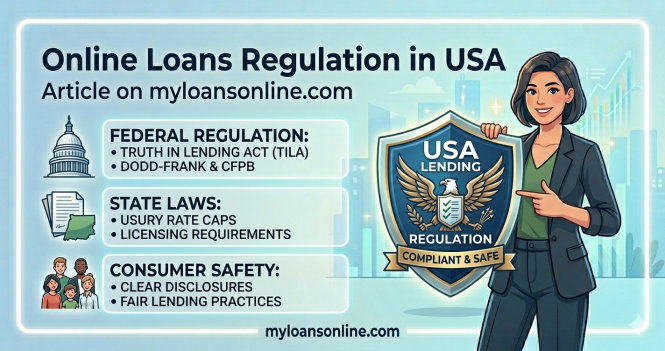
Online loans in the USA are governed by a complex, dual-layered framework. Both federal and state laws dictate licensing, maximum interest rates, and consumer protections. Lenders must comply with the laws of the consumer’s resident state, as well as comprehensive federal statutes enforced by the CFPB and FTC.
Federal Regulations
Federal laws primarily focus on fair lending practices, transparent disclosures, and anti-discrimination:
- Truth in Lending Act (TILA / Regulation Z): Mandates that lenders clearly disclose the Annual Percentage Rate (APR), finance charges, payment schedules, and total repayment amounts before the loan is finalized. This also covers emerging digital products like Buy Now, Pay Later (BNPL) services.
- Equal Credit Opportunity Act (ECOA): Prohibits lenders from discriminating against applicants based on race, color, religion, national origin, sex, marital status, or age.
- Fair Debt Collection Practices Act (FDCPA): Restricts how and when third-party debt collectors can contact borrowers, prohibiting harassment or deceptive collection tactics.
- Fair Credit Reporting Act (FCRA): Regulates the collection, dissemination, and use of consumer credit information by credit bureaus.
- Military Lending Act (MLA): Caps the annual percentage rate (APR) at 36% for active-duty service members and their dependents on certain credit products.
- UDAAP: Empowers regulators to penalize lenders for “Unfair, Deceptive, or Abusive Acts or Practices”.
State Regulations
While federal laws protect consumers broadly, state laws dictate exactly how much a lender can charge.
- Usury Limits: Each state sets its own maximum interest rates and fee caps. State limits vary drastically, meaning a lender operating in California must follow different rate rules than one in Texas or New York.
- Licensing Requirements: Non-bank lenders and online brokers typically must be licensed in the states where their borrowers reside.
- True Lender Doctrines: Regulators monitor “rent-a-bank” schemes where an out-of-state bank (which is federally exempt from state usury limits) partners with a non-bank online lender to originate loans and bypass state caps.
Key Regulatory Bodies
- Consumer Financial Protection Bureau (CFPB): The primary federal agency overseeing consumer financial products, including online and marketplace lenders. It enforces federal rules and monitors market compliance.
- State Regulators: State Departments of Financial Institutions (DFI) or equivalent bodies handle licensing and auditing of non-bank lenders.
- Federal Trade Commission (FTC): Protects consumers against deceptive, misleading, or unfair online advertising and business practices.


